


Main Visual


About Annex Building Exhibition
DAECHEONG HO
MUSEUM OF ART


CHEONGJU
ART STUDIO
-
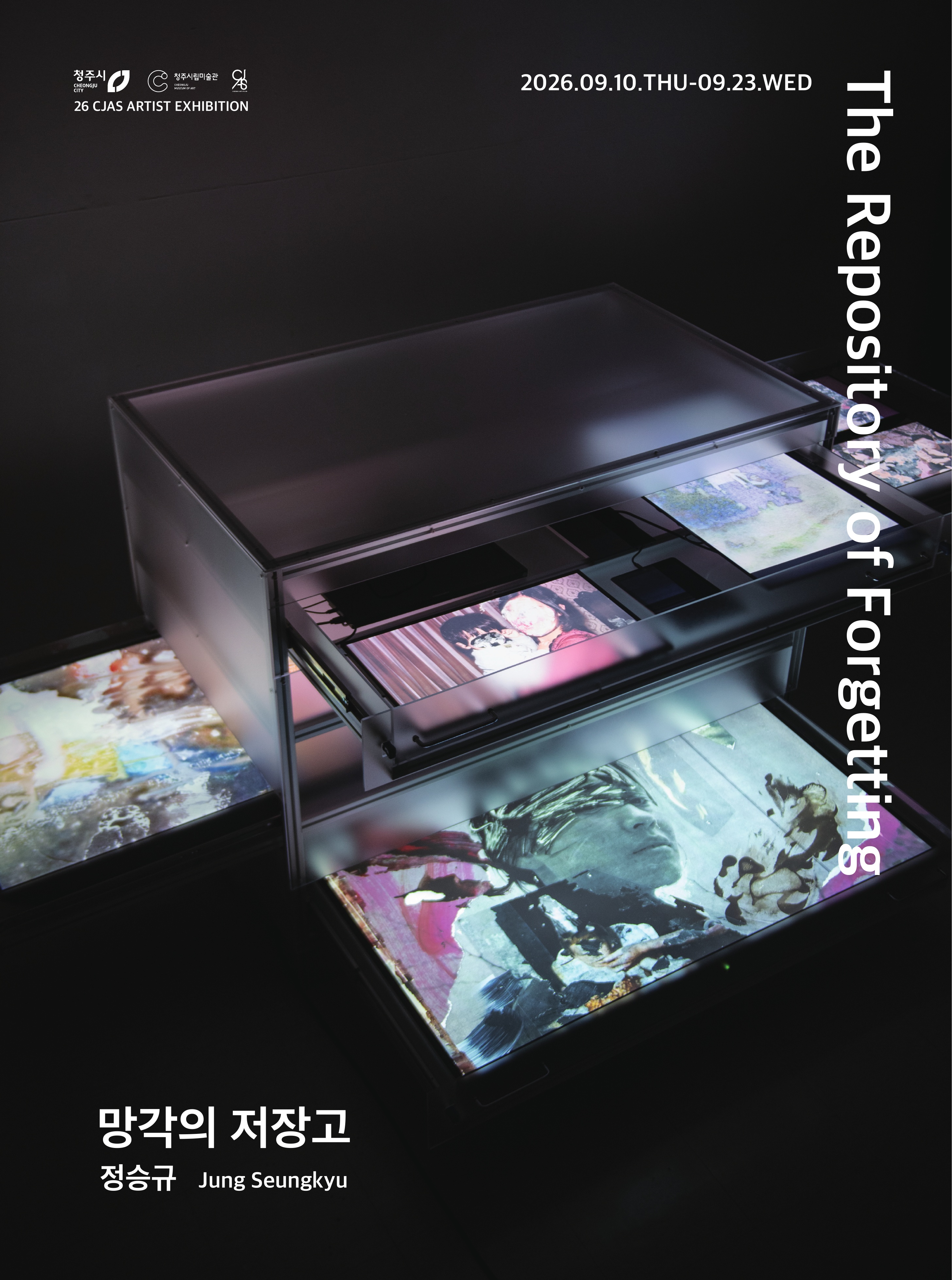 The Repository of Forgetting
2026 Cheongju Art Studio Relay Project Solo Exhibition
Cheongju Art Studio presents the 2026 Relay Project Solo Exhibition, a series of exhibitions showcasing the creative outcomes produced by its fourteen 20th-residency artists during their residency. Running from July 30 to December 30, 2026, the project unfolds over seven sequential exhibitions. The second exhibition in the series features Jung Seungkyu and is titled The Repository of Forgetting.
The year before last, my father passed away in the intensive care unit, and shortly after, my mother was diagnosed with Alzheimer’s disease. Within a year, her delusions, paranoia, and obsessions began to devastate both her and those around her. Seeing her unable to operate even the rice cooker or the television, I brought her to live with me starting last year. Both of her parents had passed away from dementia, and she had been their primary caregiver until the end. Because of this, she always worried about Alzheimer's and tried desperately to prevent it, but she could not overcome the disease etched into her genes.
Inside my mother's room lies a drawer where mundane, everyday objects are peculiarly concealed. Within it, an assortment of odds and ends—scissors, candies, tissues, toys, and plastic bags—are tucked away in layers among her clothes, as if they were precious treasures. This is a manifestation of the "delusion of theft," a common symptom of dementia. Unable to cope with the anxiety of forgetting where she placed her belongings, her mind triggers a defense mechanism: the firm belief that "someone has stolen my things." Observing this sheer chaos within the drawer, the objects appear to be a direct reflection of my mother's mind, a space now filled with confusion and fragmented memories.
In another space, I present a video work accompanied by a fabric installation that visualizes the temporal gaps and distortions of memory. I reconstructed my memory of a scene from an Alfred Hitchcock film after a lapse of a week or a month. The discrepancies and voids that emerged over time were expressed through techniques of painting over, dissolving, or cutting out.
The imagery of these distorted and fading memories intertwining in chaos is projected through overlapping layers of mesh fabric, which serves as a "veil of memory." Through these multidimensional screens, the audience is invited to drift through a landscape of incomplete memory—a place where reality and illusion, truth and delusion inextricably overlap.
Losing one's memory is not merely about failing to recognize people or forgetting certain events. To lose one's memory is to lose oneself. And to prevent this loss, the self triggers defense mechanisms like delusions and confabulation, desperately trying to protect its existence. However, this process often destroys the people around them. Habits, dietary preferences, personality, and even physical responses change as memories alter or fade, ultimately leading to the loss of one's identity as "I." That is why, these days, I find myself asking the question: "Is memory who I am?"
Yet, the moment I realize that my memory—our memory—is always incomplete, uncertain, and sometimes distorted, I finally begin to understand the anxiety, fear, and imperfection inherent within me. And even at this very moment, I am unable to take a single step away from the anxiety and fear that "I have nothing more to show."
-
 A Story Filled with Blanks / A Story to Be Filled from the Blanks
2026 Cheongju Art Studio Relay Project Solo ExhibitionCheongju Art Studio presents the 2026 Relay Project Solo Exhibition, a series of exhibitions showcasing the creative outcomes produced by its fourteen 20th-residency artists during their residency. Running from July 30 to December 30, 2026, the project unfolds over seven sequential exhibitions. The third exhibition in the series features Hong Junho and is titled A Story Filled with Blanks (A Story to Be Filled from the Blanks).
For many years, I have collected early photographs in various formats from flea markets, images that have lost their origins and narratives. With no way of knowing who made them, why they were made, or where they came from, these images have lost their names and histories, remaining behind as mere antiques. Rather than assigning new names to what cannot be known, I have turned my attention to the images and material traces left behind where names have disappeared.
Around 2023, at the Vanves flea market in Paris, I came across twelve glass plate negatives containing photographs of paintings. As I traced these images, I encountered the name A. Sardin. A small signature remained visible on the works captured in the plates, yet only a few fragmentary records survived, offering little insight into the life of the person behind the name. After roughly a century, the plates found their way to a flea market; through my act of collecting them, they were brought once again into the present.
I do not attempt to fill these blanks by narrating or reconstructing his life. Instead, I repeatedly scan the surviving glass plates, intervening in the way the scanner reads the images. I alter light and color, layer images scanned in different ways, and at times allow the machine to misread them. In this process, the plates lose their accuracy as records. Faces and bodies fade, while colors absent from the original images emerge. At the same time, scratches, stains, and damage on the glass become increasingly visible, revealing the material traces of time.
Rather than restoring the past, I create another image between the past and the present.
All I know is the signature A. Sardin left within these images. Between that name and the person I cannot know lie countless blanks. But must these blanks necessarily be understood and filled? Perhaps a person's life and an image are constituted not only by recorded facts, but also by what has disappeared, what remains unknowable, what has been misread, and what is imagined.
A Story Filled with Blanks / A Story to Be Filled from the Blanks begins with this state of not knowing. Rather than writing a single definitive answer into these blanks, I bring the images back into the present, leaving them in a state where record and error, fact and speculation, memory and forgetting can overlap. I leave space for viewers to construct their own stories somewhere between what they can see and what they cannot know.
A blank is where a story has disappeared, and at the same time, where another story can begin.
OCHANG
GALLERY


THE MEETING OF
CONTEMPORARY ART
AND SPACE
CHEONGJU MUSEUM OF ART
contents can be maximized to be used as a space for
communication with the citizens.
CHEONGJU
MUSEUM OF ART
Annex
Building
-

Daecheong ho Museum of Art
A cultural art space where the beautiful natural
scenery of Daecheongho Lake and Cheongnamdae
Presidential Villa are in harmony

-

Cheongju Art Studio
A space is provided for the exhibition of outside artists
and the personal and planned exhibitions of resident
artists and artists’ studios.
-

Ochang Gallery
Contemporary Art Exhibition Hall Located on
the Second Floor of Cheongju Library
site information
-
(28654) 50, Chungnyeol-ro 18beon-gil,
Seowon-gu, Cheongju-siT043-201-2650 F043-201-2659 -
(28208) 721, Daecheonghoban-ro,
Munui-myeon, Sangdang-gu, Cheongju-siT043-201-0911 F043-201-0915 -
(28774) 55, Yongam-ro, Sangdang-gu,
Cheongju-siT043-201-4058 F043-201-4059 -
(28120) 102, Ochanggongwon-ro, Ochang-eup,
Cheongwon-gu, Cheongju-siT043-201-2651 F043-201-2659

